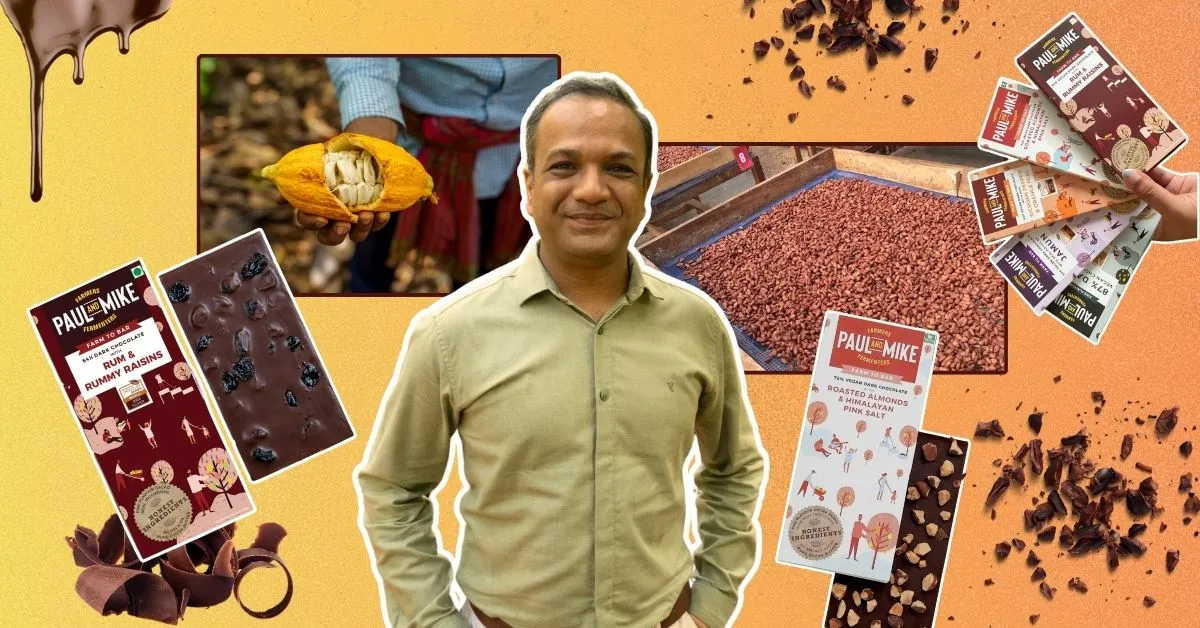
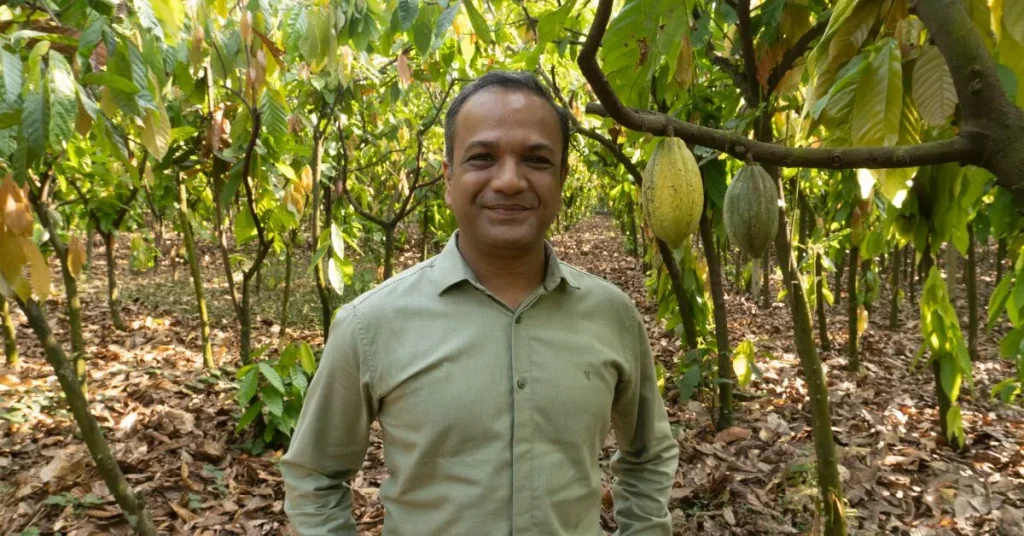
Think about your first memory of chocolate. Was it Cadbury after school, a Dairy Milk tucked into a birthday gift, or a Five Star from your local bakery? Chocolate, back then, was just chocolate. Most of us didn’t think of where it came from. We didn’t think about the cocoa bean, the farmers who grew it, or if chocolate could reflect the flavour of its birthplace. That is, until Vikas Temani, the founder of Paul & Mike, did.
His curiosity led him to the cacao plantations of Latin America. In 2019, he founded Paul & Mike, a bean-to-bar chocolate brand from Kochi. Since then, the brand has won prestigious chocolate awards and changed how Indians view chocolate.
Today, Paul & Mike exports to several countries and has become one of India’s most celebrated craft chocolate brands, proving that Indian cacao deserves a place on the global stage.
Check Out: Mellow Peanut Butter: The Story of Kerala’s Homegrown Peanut Butter Brand
How Paul & Mike Began
Vikas works with Synthite Industries, the Kochi-headquartered company best known for spices, essential oils and food ingredients. Being based in Kerala meant he was already surrounded by one of India’s largest cocoa-growing regions. But he soon understood that very little of it found its way into premium Indian chocolate.
“When we started studying chocolates, we realised that almost all the premium chocolates in India were imported,” Vikas tells me. “Being so close to Kerala’s cocoa-growing belt, we felt perhaps we could build a premium chocolate brand ourselves.”
India was not known for fine chocolate. Supermarket shelves were filled with imported brands. If someone wanted premium chocolate, they usually chose names like Lindt or Godiva. Starting another chocolate company made sense only if there was something truly unique about it. And most importantly, a chocolate that could be at par with international standards of quality chocolate.
“You can’t just have the same beans or the same quality as Cadbury or even Lindt if you want to differentiate yourself,” he says. “You need to bring in something new.” The entire philosophy behind Paul & Mike stems from there.
Instead of studying what Indian chocolate brands were doing, Vikas decided to look at the world’s best chocolate-producing countries. Latin America, to be specific. This region is considered home to some of the finest cocoa beans on the planet. Countries like Ecuador, Peru and Colombia have spent generations perfecting the art of growing and fermenting fine-flavour cacao. Vikas believed learning from these countries was essential if India wanted to produce world-class chocolate.
Also Read: Good Conscious Co.: A Clean Everyday Home Fragrance Brand from Kerala
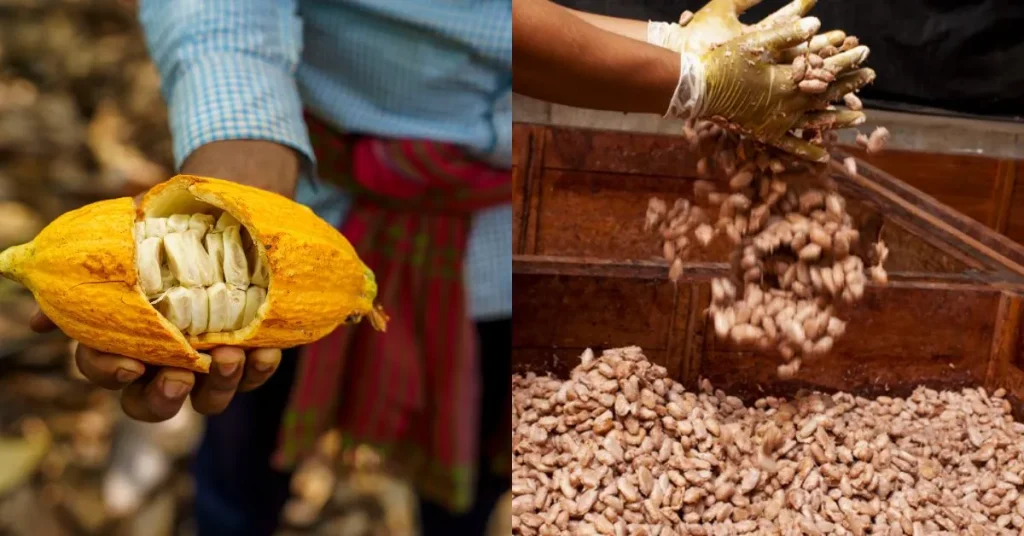
Vikas travelled through plantations, attended an international cocoa conference, met estate owners and chocolate makers, and spent time understanding something most consumers never think about: what happens before chocolate is even made.
“I wanted to understand what fine cacao was all about,” he says. “What role genetics play, what role fermentation plays, how the supply chain works and, of course, to taste those chocolates and really understand the difference between what we were used to and what existed elsewhere in the world.”
One of his key realisations was about the bean. Most commercial chocolate worldwide uses bulk cacao, mainly sourced from parts of Africa, Indonesia, and even India. These beans are suitable for mass-market chocolates, where sugar, milk, and flavourings dominate the flavour profile. Fine-flavour cacao is different. Similar to speciality coffee, its flavour depends on its growing location, plant genetics, and how the beans are fermented and dried after harvest.
With this knowledge, he returned to Kerala, where a unique form of cacao is grown. Although its flavour profiles differed from those he encountered on his travels, he saw potential. That’s how Paul & Mike was created, named after the farmers he met on his cacao tour in Latin America.
But I wanted to know: Could Indian cacao really compete with the best in the world?
What’s Unique About Indian Cacao?
“It’s actually a difficult question,” he laughs. “People ask me, ‘What does Indian cacao taste like?’ But how do I answer that? Based on my experiments, Indian cacao can taste like many different things.“
To understand this, you need to realise that chocolate’s journey starts long before it reaches the factory. The white beans in a cacao pod do not taste like chocolate. Their distinct flavours develop only after fermentation, drying, and roasting. This process is remarkably similar to coffee or wine, where the same fruit can produce varied flavour profiles depending on its handling after harvest. This was Vikas’s biggest lesson from Latin America. Fine chocolate relies on understanding what happens to those beans before they become chocolate.
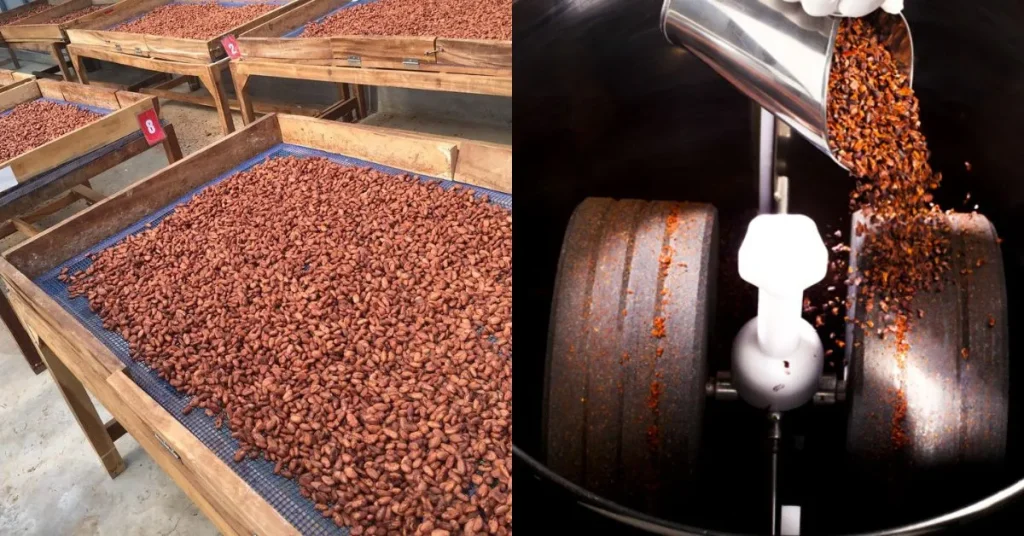
Back in Kerala, he and his team began experimenting with fermentation. The same Indian cacao beans were fermented using different techniques, each producing a completely different personality. “One fermentation gives us slightly banana notes,” Vikas explains. “Another gives us a floral jasmine note. And with another fermentation style, we get something that’s more raisin-like or wine-like.”
A yellow fermentation creates fruity, banana-like flavours. A white fermentation brings out delicate floral notes. A red fermentation develops richer, wine-like characteristics. They’re all made using Indian cacao, yet they taste remarkably different. That’s why Vikas believes there isn’t a singular flavour that defines Indian chocolate. “For me,” he says, “all these red, yellow and white fermentations are Indian cacao.”
“Is Indian cacao the best cacao in the world? It is not, I’ll be honest. But is it good? Is it very good? Yes, it can be very good.”
You Might like: Hotto: How Three Gym Friends Built a Healthy Nut Spreads Brand from Kerala
Paul & Mike’s First Breakthrough
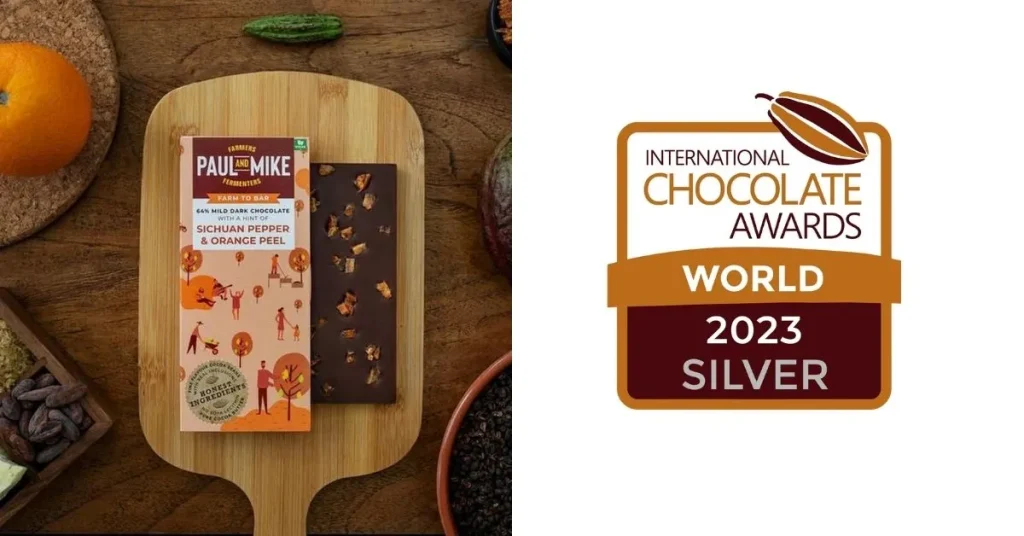
Paul & Mike’s chocolates have gone on to win multiple honours at the International Chocolate Awards, one of the most respected competitions in the industry. Competing against established chocolate makers from Europe and the Americas, the Kerala-based company proved that Indian cacao could stand shoulder to shoulder with some of the finest chocolates in the world.
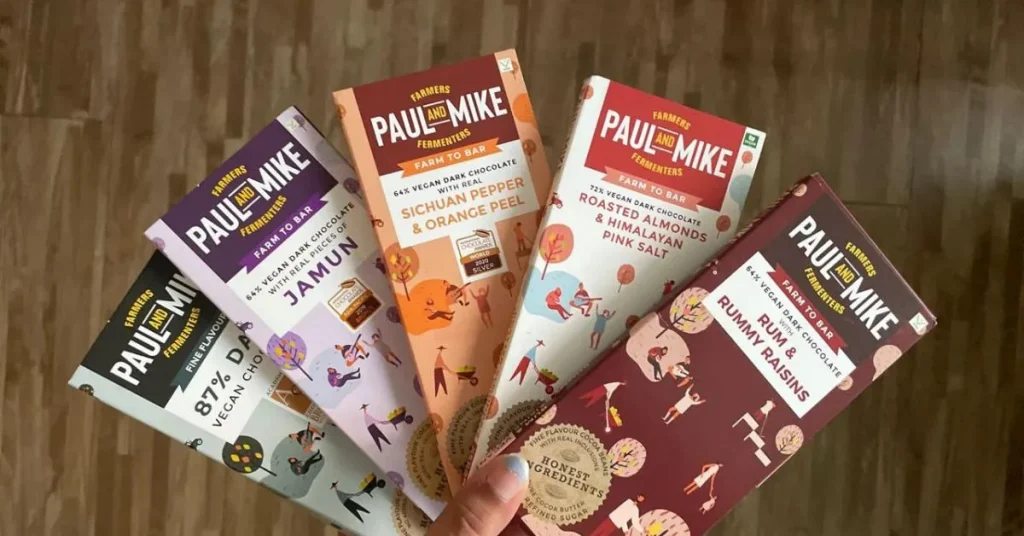
“Our first breakthrough came when we won our first international award,” he recalls. “Our Sichuan Pepper and Orange Peel chocolate won silver at the world level. During COVID, that story went viral. Journalists picked it up, and suddenly we had brand recognition across the country.”
That single award introduced the brand to a much wider audience. People who had never heard of Paul & Mike suddenly discovered that an Indian chocolate company had beaten some of the world’s most celebrated chocolatiers on an international stage. More importantly, it challenged a long-held assumption that premium chocolate had to come from Europe.
Paul & Mike’s Flavour Inspirations
Paul & Mike’s flavours aren’t what most people usually think of when they hear “chocolate,” and that’s what makes them stand out. The process for these ideas isn’t as random as it may seem.
“It works in three ways,” Vikas explains. “One is that we follow trends. Ultimately, you’re running a business, so you have to make what people want. You can’t do it for yourself all the time.” When Dubai’s now-famous Kunafa chocolate began taking over social media, Paul & Mike joined the trend too. But, true to its philosophy, the company wanted to do it properly. Their version, Vikas says, contains one of the highest percentages of pistachio available in an Indian Kunafa chocolate.
The second source of inspiration comes through collaborations. Over the years, Paul & Mike has worked with several Indian brands, often creating flavours that would probably never have existed otherwise. One of the biggest successes came through a collaboration with Eleftheria Cheese, resulting in the Brunost chocolate. “It actually became one of our best sellers,” Vikas says. “For a few months it was our number one seller, and even today it’s among our top three or four.” Another collaboration with Tea Trunk led to a Matcha chocolate, while a custom project eventually gave birth to one of the company’s enduring favourites, Rum and Rummy Raisins.
Sometimes, the most unexpected ideas leave the biggest impression. Years ago, Paul & Mike partnered with Simba Beer to create a beer caramel chocolate. It sounded outrageous enough to grab attention, but there was genuine craftsmanship behind it. “We actually used to get their beer bottles, boil them and make caramel out of the beer before filling the chocolates,” Vikas recalls. “Even people who didn’t buy it noticed it. Even today, people ask us when we’re bringing it back.” Unfortunately, working with alcohol in India comes with its own regulatory headaches, making the collaboration difficult to continue. But the experiment perfectly captured the spirit of the brand. That, if an ingredient has the potential to create an interesting flavour, it’s worth trying.
Today, trends have shifted again. Health-conscious consumers increasingly prefer dark chocolate, while the Dubai chocolate trend has created a new audience. According to Vikas, the brand’s current bestsellers reflect this change. The Dubai chocolate ranks highest, followed by the 72% Dark Chocolate with Almonds, while Rum and Rummy Raisins continue to be one of the company’s most popular bars.
Also Read: Alcohol Brands Started By NRI Malayalis
Biggest Challenge So Far
For all the awards and unusual flavours, Vikas believes the biggest challenge is still education. Most people simply don’t know what chocolate actually is. “A lot of people don’t even know chocolate comes from cocoa,” he says. “They don’t know what a cocoa pod looks like. They don’t know that the beans have to be fermented before chocolate flavour develops. They just know there’s some brown thing, sugar goes into it, and that’s chocolate.”
Looking back now, Vikas admits there are things he would have done differently. If he were starting Paul & Mike again today, he says he would have entered the health segment much earlier. “When we launched, we focused on fine flavour chocolate and cacao quality. I would still do that. But I think I would also have realised much sooner that Indian consumers are increasingly concerned about sugar.” He also wishes the brand had entered airport travel retail earlier, recognising that premium Indian chocolates make ideal gifts for both tourists and Indians travelling abroad.

Towards the end of our conversation, I ask him a question unrelated to chocolate. Having spent over fifteen years in Kerala despite being from Rajasthan, what does the state mean to him today? He doesn’t pause for long. “I love Kerala,” he says. “I’ve lived here for almost 15-16 years now. Kerala is home to me. Kerala, to me, is peace.”
It’s a fitting way to end the story because, in many ways, Paul & Mike is a product of Kerala as much as it is of Vikas’ curiosity. A Rajasthani entrepreneur arrived in a state known for spices and cocoa, travelled halfway across the world to learn from the best, returned with new ideas, and spent years proving that Indian cacao deserved to be taken seriously.
So today, when you unwrap a bar of Paul & Mike, know that you are tasting years of experimentation, countless fermentation trials, collaborations with fellow Indian brands, and one man’s belief that world-class chocolate didn’t have to come from Switzerland or Belgium. It could begin on a cocoa farm in Kerala.
Must Check Out: This Malayali Founder Built C’s The World, a Series of Geography Games for All Ages