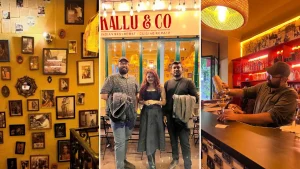

Fort Kochi comes alive in a very specific way during Kochi-Muziris Biennale season; streets feel fuller but not frantic, conversations spill out of cafés and pubs, and art quietly enters everyday life (much like it always has here) without asking for permission. This is not a Biennale you can finish in a weekend.
If you’re coming with the expectation to see everything in a day or two, consider this a gentle warning from someone who knows the city a little bit: this edition asks for time. Time to walk, time to sit, time to return to places, and time to let the city reveal itself between venues.
Titled ‘for the time being’, the 2025–26 Kochi-Muziris Biennale curated by Nikhil Chopra is rooted in the present — in bodies, processes, friendships, and the everyday rhythms of Kochi itself. Rather than centering spectacle or scale, this Biennale is an invitation to stay with things as they unfold, to be attentive to what exists now, and to experience art as something lived alongside the city rather than placed on top of it.
As someone from Kochi, this approach feels intuitive. I wrote about this for ELLE India – about how this Biennale doesn’t just occupy the city but is shaped by it, how Fort Kochi in particular becomes more itself during these months: more porous, more curious, more willing to host strangers and ideas at the same time. This guide grows out of that same place of familiarity rather than distance.
This approach feels intuitive because this is a city that doesn’t rush its conversations or its afternoons, that reveals itself slowly through repeated visits and familiar walks. The Biennale leans into that sensibility, spreading itself across Fort Kochi, Mattancherry, and Willingdon Island, and even in Ernakulam City at Durbar Hall; all asking you to take your time and to be here, now.
Consider this your PinkLungi Biennale Guide – not a checklist, but a companion for navigating it at a pace that does justice to both the art and the city. Think of it less as directions and more as me walking alongside you, occasionally pointing things out that you may have missed and suggesting you sit down and just watch the sea for a bit too.
First, Understand the Shape of This Biennale
The 2025–26 Kochi-Muziris Biennale unfolds across 22 main venues and a wide network of collateral projects selected through an open call. These collaterals are not afterthoughts — they are integral to how this Biennale thinks about the city, labour, making, pedagogy, community, and everyday life.
The venues are organised into three loose, walkable clusters:
- Fort Kochi
- Mattancherry
- Willingdon Island
The idea is simple: reduce travel stress, reduce carbon footprint, and encourage people to experience the city at ground level. If you can avoid bringing your car, do. Kochi’s Water Metro, or the ferry, is not just convenient – it’s genuinely one of the best ways to see the Biennale.
Where to Begin: Fort Kochi (Ease Into It)
Start at ABC Art Room.
Originally conceived as a space focused on children and pedagogy, ABC has grown into one of the Biennale’s most generous venues. Across the Biennale’s 110 days, it hosts workshops, demonstrations, conversations, and hands-on sessions – from drawing and painting to craft, print, and interdisciplinary practices.
Entry is free, the energy is welcoming, and something is always happening. It’s the perfect place to arrive, recalibrate, and remind yourself that this Biennale values process as much as finished work. Even if you don’t participate in the workshops, you can still see creation in action here.
From ABC, walk.
This matters. Fort Kochi itself has been folded into the Biennale’s design. As you move through the streets, you’ll encounter murals, graffiti, public installations, pop-up projects, cafés doubling as venues, and people who are very much part of the exhibition — artists, students, locals, visitors, all overlapping.
Next, head to Aspinwall House.
Buy your ₹200 day pass here. Or you can get yourself a season pass at the venue or online. This ticket covers Aspinwall House and a select number of primary venues. Spend the extra ₹30 on the physical Biennale map — it links to a Google My Maps version that makes navigating the city far easier than relying on instinct alone.
Unlike all the earlier editions, Aspinwall House hosts around 25 exhibits this year – significant, but not exhaustive. Treat it as just the beginning, not the whole story.
Fort Kochi venues you can cover on foot
Most Fort Kochi venues sit within 100–350 metres of each other, making this cluster easily walkable:
- ABC Art Room (multiple creative workshops/classes every day)
- Aspinwall House
- Pepper House
- Bastion Bungalow (invitation project)
- The Pavilion (talks, performances, official programming)
- Jail of Freedom Struggle (invitation project)
- David Hall (invitation project, with Pandhal Café)
- Oy’s Cafe (Collateral)
- St. Andrew’s Parish Hall and Artshila (Student Biennale venues; St. Andrew’s also hosts a Kochi Biennale Foundation special project)
- Parade Ground (venue for live events)
Take breaks. Sit down. Get chai. This Biennale rewards unhurried looking.
Collaterals: Where Kochi Really Speaks
If the main venues give you the Biennale’s structure, the collateral projects take you to its local pulse. These projects occupy studios, cafés, warehouses, and hybrid spaces across Fort Kochi and Mattancherry. They are research-led and deeply rooted in specific practices, histories, and communities. Some collaterals to seek out:
Fort Kochi Collaterals
Looming Bodies by Lakshmi Madhavan Studio
A photographic and textile-based project engaging with kasavu weavers of Balaramapuram. Hands, feet, loom parts, gestures, and fragments of daily work are treated as archival material and are centered by a woven kasavu installation. The sound of the loom echoes through the space. It’s quiet, rigorous, and best experienced slowly.
Like Gold / പൊന്നു പോലെ — Rizq Art Initiative
This project takes gold – as material, metaphor, and economic force, and traces its meanings across the Malabar coast, trade histories, and contemporary circulation and between the Middle East and Kerala. The title itself borrows from a Malayalam idiom, grounding the work firmly in place while opening outward into questions of value, migration, and exchange. Especially biting is the work by Indu Antony titled ‘I raised her like gold’ – talking to the sharp emotional edge of a line that most Malayali women have heard growing up, depicted in a unique way.
Oy’s Cafe
At this cafe space in Burgher Street, close to the famous Kashi Cafe, you’ll find the Naina Dalal: An Empathetic Eye Collateral project curated by Girish Shahane, and presented by Gallerie Splash. It brings together a select work spanning seven decades from the modernist artist and her drawings, paintings, and prints that speak to themes of memory, resilience and a reflection of the lived experience of people.
Mattancherry Collaterals
Monsoon Culture
A Kerala-rooted project that examines identity and social structures through multidisciplinary research. Expect exhibits that make you uncomfortable by showing you lived experiences and exhibits that probe you to look beyond your privilege.
Parallax – Forplay Society
An artist-run, participatory space from Ernakulam that prioritises gathering, conversation, and collective presence over static display. Arrive open to interaction.
Durga Puja Art: The Living Museum of Bengal’s Public Art
A project translating the spatial language of Durga Puja pandals into Kochi’s context — loud, architectural, communal, and rooted in public-making traditions shared across port cities.
Additional Mattancherry & Fort Kochi Collaterals
Venues such as Mocha Art Café, Arrow Mark (Nosh Haus Cafe), GRC Marine, KM Building, and others host smaller, site-responsive projects and pop-ups. Many are clustered close enough to be discovered while walking — let that happen.
Mattancherry is where the Biennale slows down
Once you leave Fort Kochi and cross over by Water Metro or take an Uber/auto to Bazaar Road, Mattancherry announces itself differently. This is not postcard Kochi – this is working Kochi. Spice godowns, old merchant homes – some restored, others dilapidated, synagogues, temples, mosques, bakeries, antique shops, and narrow roads where lorries, cycles, tourists, and aunties all co-exist daily.
Historically, Mattancherry has been Kochi’s trading spine – pepper, cardamom, clove and ginger moving through these lanes for centuries, shaped by Arab, Jewish, Gujarati, Konkani, and Malayali presences. That layered history is exactly why the Biennale works so well here. Contemporary art doesn’t arrive as an interruption; it arrives as a continuation.
This cluster is slightly more spread out than Fort Kochi, but still very walkable if you approach it like a local – leisurely pace, water bottle in hand, snack breaks where needed. Expect heat, smells of spice and varying languages overlapping, and artworks on the street that reveal themselves to you, only if you choose to look.
Get down at the Mattancherry Water Metro station. From here, everything unfolds on foot. Use the Biennale map we’ve shared and keep your eyes peeled – venues are clustered closely enough that you’ll often walk into the next one without realising you’ve left the previous.
What You’ll Find, Venue by Venue
Monsoon Culture
A studio-led, Kerala-rooted space where textile, material research, and social structures come together. Expect installations and programmes that feel familiar but probing — the kind of work that asks questions using things we already know.
Arrowmark (Nosh Haus) / Mocha Art Café / GRC Marine
These hybrid venues blur art and everyday life. Expect smaller installations, sound works, pop-up exhibitions, and experiments that don’t need white walls. Good places to pause, sit, sip something cold, and let the work speak to you.
Ootupura Pazhanur Bhagavathy Temple (Invited Project)
A traditional temple space hosting a Biennale invitation project. The experience here is less about spectacle and more about resonance – contemporary work placed gently within a living, local site.
VKL Warehouse (Students’ Biennale)
Raw, energetic, and unpolished in the best way. Student works here often feel urgent — early questions, bold attempts, and ideas that haven’t been smoothed out yet.
Cube Art Spaces
A compact but layered venue hosting invited projects alongside Kochi Biennale Foundation special works. Expect a mix of archival material, installation, and occasionally performance-led practices.
Simi Warehouse / Garden Convention Centre / Devassy, Jaison & Sons
Large warehouse-style venues that give artists room to breathe. These spaces often hold residency outcomes, sculptural works, and video installations — places where you slow down and spend time.
Anand Warehouse / SMS Hall / BMS Warehouse / III Markaz & Café
A dense run of venues that feel almost maze-like. You’ll experience around 20 artists’ work collectively through these venues, and you will move from immersive installations to stunning paintings and find yourself in conversation with people you might meet there about said works, without even trying.
Arman Collective & Café – Edam
A favourite stop. Edam foregrounds Malayali artists, presented inside a café setting. Look, linger, talk, but this one feels grounded, warm, and very Kochi.
Between the Venues
This is where Mattancherry really shines. Walk through Gujarati Road. Smell the spices. Pop into Shantilal’s for sweets or Kayees Rahmathulla for biryani. Walk down Jew Town. Duck into antique shops and old godowns that feel like they’ve barely changed, except now there’s an artwork quietly waiting inside. Mattancherry shouldn’t rush you — it will ask you to linger a little longer, like all the people who came generations ago and have made homes here.
Willingdon Island: End With Space to Breathe
From Mattancherry or Fort Kochi, take the ferry or Water Metro to Willingdon Island. The Island Warehouse hosts work by 12 artists, including LaToya Ruby Frazier and Marina Abramović. The scale, pace, and openness of the space make it feel like a pause – a good place to reflect after the city’s density.
Now onto some Practical Kochi-Muziris Biennale Hopping Advice
- Wear something comfortable. Choose cotton clothes and comfortable shoes.
Note: Sure, your cutest fit pics might look cool between the art for the ‘gram, but you definitely will feel the heat and the blisters later on. - Carry a bag with enough space for a refillable water bottle, umbrella, sunscreen and even some snacks if needed.
- Join the Kochi-Muziris Biennale WhatsApp channel for daily programme updates and timely updates.
- Performances happen throughout the day — you will miss some, and be okay with that.
- Eat locally. Have soda sarbath, cutlets, and palaharam sold by Fort Kochi home-makers near Aspinwall. In Mattancherry, stop at Shantilal’s Mithaiwala or Kayees Rahmathulla Biryani. Check out Pandhal Café inside David Hall and Lila Art Cafe too. End a long day with beer or wine at Francis or Seagull, if you can get a table.
Shops to Explore:
There are beautiful stores to check out all around the locale.
- Pepper House Design Shop and One Zero Eight by Save The Loom for curated luxury fashion and lifestyle brands from across India.
- Some beloved homegrown brands have set up temporary Biennale outposts with curated additions from other brands — House of Vandy on Quieros Street, Ink Pikle inside Mocha Art Café, SALT Studio’s Chavittunadakam themed curated store, and a collaborative pop-up shop by Alka Hari, Found Objects and Art By Vineetha near Hotel Seagull.
- If you’re heading to Durbar Hall, explore the flagship store of Rouka by Sreejith Jeevan, which is a stone’s throw away and houses his Kerala-rooted and crafted garments and select curios he curates.
They’re part of the experience too; don’t rush past them. You may never know what you’d end up discovering there, or who you might meet there.
Final note: choose to pause and experience this Biennale deeply, rather than rushing to cover everything
This Kochi-Muziris Biennale asks you to pause, consider, and linger – the very way of life that Fort Kochi is known for. Walk if you can. Ferry when you’re tired. Sit and imbibe the art that speaks to you. Talk to people. Miss a venue or two. Come back the next day. The Kochi-Muziris Biennale 2025–26 isn’t something you complete. It’s something you move through – slowly, sociably, and very much on Kochi’s terms.